
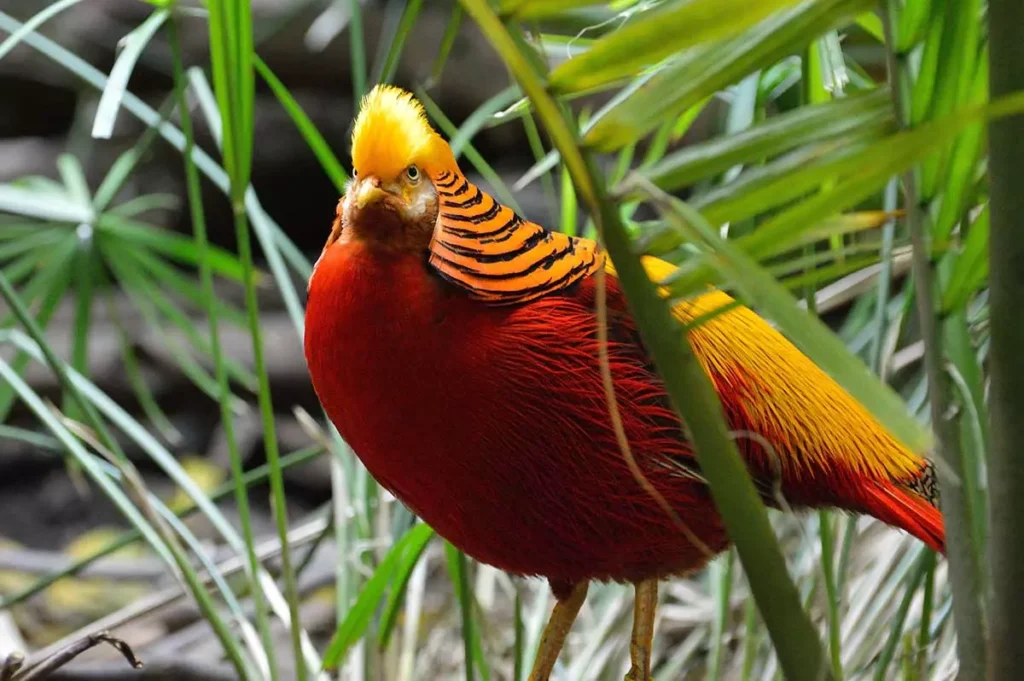
Below you’ll find everything you need to know about the golden pheasant: its biology, natural habitat, behavior, captive care requirements, and legal status.
Quick facts
| Attribute | Detail |
|---|---|
| Scientific name | Chrysolophus pictus |
| Common names | Golden pheasant, Chinese pheasant, rainbow pheasant |
| Size (male) | 90–105 cm total length (tail accounts for ~65 cm) |
| Size (female) | 60–80 cm total length |
| Weight | 630–700 g (male); 550–650 g (female) |
| Lifespan | 5–6 years in the wild; up to 15 years in captivity |
| Native range | Central and western China (Sichuan, Shaanxi, Guizhou) |
| IUCN status | Least Concern |
| Good pet? | Conditional (aviary bird, not a companion animal) |
Appearance
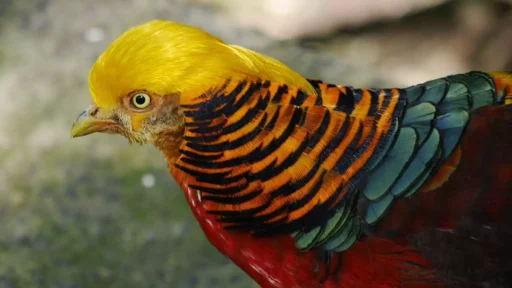
Adult male
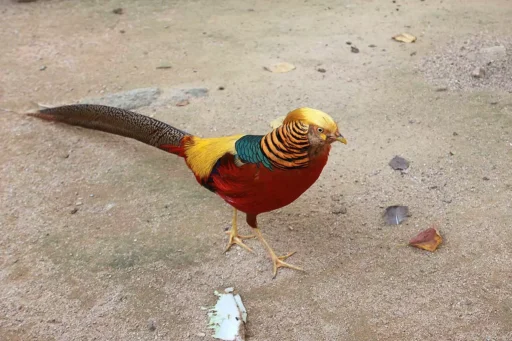
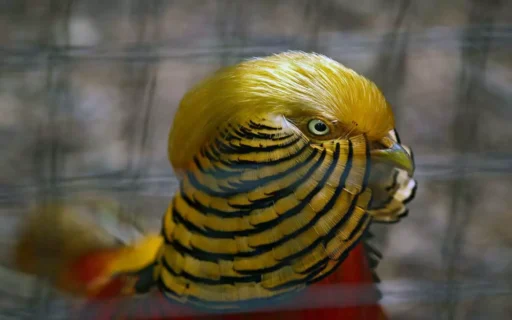
The adult male golden pheasant is built around contrasting blocks of intense color. The crown and upper back are covered in deep golden-yellow feathers that form a long, silk-like crest. Immediately below, a broad ruff of orange-and-black barred feathers (often called the “cape”) fans out during courtship to frame the face completely. The mantle is metallic green, transitioning into a bright scarlet chest and belly. The tail — responsible for more than half the bird’s total length — is pale buff barred with dark brown and cinnamon, producing a rippling, lacework effect in motion.
The bare skin around each eye is light blue, surrounding a bright yellow iris with a pinpoint black pupil. The bill and legs are yellow. No other pheasant species combines this many saturated hues in a single individual.
Adult female
Female golden pheasants are dramatically different: predominantly brown, buff, and barred, with a pattern that blends seamlessly into the leaf litter. This cryptic coloration is not a design flaw — it is essential protection during the long incubation period when the female sits motionless on her nest. The face and underparts are pale buff; the upperparts are barred dark brown and tawny. Yellow legs are one of the few color details she shares with the male.
Occasionally, females display abnormal plumage with flashes of color approaching male intensity, though this is rare and likely linked to hormonal variation.
Habitat and distribution
Golden pheasants are native to the dense mixed forests and bamboo undergrowth of central and western China, with the core range covering the provinces of Sichuan, Shaanxi, Guizhou, Hubei, and Yunnan. Elevations between 500 m and 2,500 m are typical, though the birds descend toward valley floors in winter.
Within their habitat, they favor areas where a relatively open forest floor allows easy foraging, while thick shrub layers or bamboo stands offer instant cover. Rocky slopes with sparse ground vegetation are also used. Although shy around humans, they have been recorded near cultivated fields during hard winters, where they take advantage of wheat and other crops.
Feral populations have become established in the United Kingdom (particularly in parts of Wales and East Anglia), France, and a few other European countries, likely descended from birds that escaped or were released from private collections. These populations are self-sustaining but small.
Diet
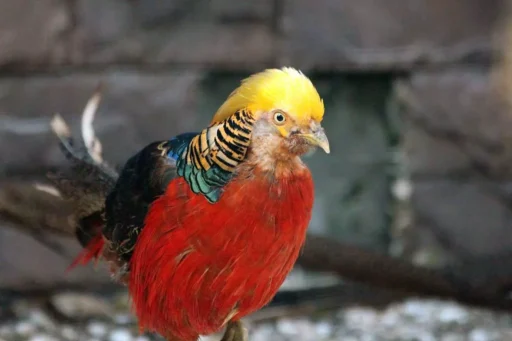
Golden pheasants are omnivores with a diet that shifts seasonally. In spring and summer, insects, grubs, spiders, and small invertebrates form a meaningful part of the intake, especially for growing chicks that need high protein. In autumn and winter, the diet shifts almost entirely to plant matter: seeds, berries, leaf buds, young bamboo shoots, and grains. They forage almost exclusively on the ground, using their bill to probe soil and scratch through leaf litter.
In captivity, a balanced diet typically consists of a quality pheasant pellet or game bird feed (around 20% protein), supplemented with dark leafy greens, chopped vegetables, fruit, mealworms, and grit. Fresh water must be available at all times. Avoid excessive fruit, which can cause loose droppings.
Behavior and personality
Temperament
Golden pheasants are naturally wary and will retreat quickly when disturbed. Males can become territorial during breeding season and may display aggression toward other males or even toward humans who enter the aviary frequently. Outside of the breeding season, they are generally calm and relatively tolerant of their keeper’s presence, though they rarely become tame enough to handle.
Courtship display
The male’s courtship display is theatrical. He spreads the orange cape fully to form a disk around his face, erects the golden crest, and circles the female with a stiff-legged, sideways walk. As he turns, the cape’s black-and-orange barring appears to “flash,” a visual signal thought to indicate fitness. At the same time, he produces a distinctive wing sound — a short, sharp rustle — that functions as both an attention signal and an alarm call when the bird is startled.
Nesting and breeding
The breeding season runs from April to June. Females choose a nest site on the ground, usually concealed beneath dense shrubs or fallen brush. A typical clutch contains 8 to 12 pale buff eggs, which the female incubates alone for 22 to 23 days. Chicks are precocial: they hatch fully covered in down and are able to follow the mother and peck at food within hours. The male takes no part in incubation or chick-rearing.
Golden pheasant as a pet (aviary bird)
The golden pheasant is not a companion animal in the way a parrot or lovebird might be. It does not seek human interaction, does not learn to talk, and does not enjoy handling. What it offers instead is an extraordinary visual display, relatively easy care compared to many exotic bird species, and compatibility with mixed-species aviaries under the right conditions.
Aviary requirements
A single pair requires a minimum aviary of 4 m × 2 m × 2 m (length × width × height). Larger is always better: the male needs room to display fully without injuring his tail. The floor should be natural earth or sand (concrete causes foot problems over time) with areas of leaf litter for foraging. Provide at least one elevated roosting perch at 60–90 cm height, dense shrubs or brush piles for the female to shelter in, and a sheltered section protected from rain and wind.
Never house two males together without a sight barrier — dominant males will stress subordinate birds severely. A ratio of one male to one or two females works well in a large aviary.
Color mutations in captivity
Selective breeding has produced several recognized mutations, including:
- Yellow golden — red body replaced by yellow; the most common mutation.
- Dark-throated golden — darker overall with reduced golden tones.
- Silver golden — pied effect with large white areas replacing gold and red.
- Cinnamon golden — warm brown tones substituted for the typical red.
Wild-type birds tend to be hardier than heavily selectively bred mutations. Price for a healthy pair of wild-type golden pheasants typically ranges from $80 to $250 USD depending on breeder and region. Rare mutations can exceed $500 per bird.
Health considerations
Common health concerns include internal parasites (regular deworming is recommended), Marek’s disease (vaccination is advisable for young birds), aspergillosis in damp conditions, and bumblefoot if kept on inappropriate substrates. An avian veterinarian familiar with gallinaceous species should provide an annual check-up; exotic bird insurance covering pheasants is available from specialist providers and is worth considering for breeding stock.
Legal considerations
The golden pheasant is listed on CITES Appendix II, which means international commercial trade is permitted but requires official export and import documentation. This applies to live birds, eggs, and feathers traded across borders.
United States: Keeping golden pheasants is legal at the federal level. Some states require a permit for keeping any live pheasant species; always check with your state’s Department of Fish and Wildlife before acquiring a bird. Interstate transport of live pheasants may require a health certificate issued by a licensed veterinarian.
United Kingdom: Golden pheasants may be kept without a license. However, releasing them into the wild requires a license from Natural England (or equivalent devolved authority), as feral populations are already established and their ecological impact is monitored.
European Union: Regulations vary by member state. CITES permits are required for import from outside the EU. Captive-bred birds with documented lineage are generally easier to move legally than wild-caught specimens. Contact your national CITES management authority for current requirements.
If you are sourcing a bird from a breeder, always request a captive-bred certificate or equivalent documentation. Exotic pet legal assistance services can help navigate permit applications for collectors in regulated jurisdictions.
Conservation status
The golden pheasant is currently assessed as Least Concern on the IUCN Red List, meaning the species faces no immediate extinction risk at a global level. Population estimates are difficult to verify given the bird’s secretive forest habits, but it is considered locally common across much of its range in China.
The main pressure on wild populations is habitat loss: deforestation and conversion of mountain forest to farmland in central China has reduced available territory over recent decades. Hunting pressure exists in some areas, though the species’ remote mountain habitat provides natural protection. Captive populations worldwide are large and genetically diverse, which reduces conservation concern further.
Frequently asked questions
How long do golden pheasants live?
Golden pheasants live 5 to 6 years in the wild. In captivity, with proper care, a well-kept bird can reach 12 to 15 years. Females generally outlive males by a year or two.
Can golden pheasants be kept as pets?
Yes, but they are aviary birds rather than companion animals. They do not tame easily and are best appreciated in a spacious outdoor aviary. They are not suitable for indoor keeping or apartment living.
What do golden pheasants eat?
In the wild they eat seeds, berries, leaf shoots, insects, and small invertebrates. In captivity, a game bird pellet with around 20% protein forms the base of the diet, supplemented with greens, vegetables, fruit, and occasional live insects such as mealworms.
Are golden pheasants legal to own?
In most of the US and UK, yes. The species is CITES Appendix II, so international trade requires documentation, but domestic ownership of captive-bred birds is generally permitted. Some US states require a state-level permit; check local regulations before buying.
How big of an aviary does a golden pheasant need?
A pair needs a minimum of 4 m × 2 m × 2 m. The male’s tail can reach 65 cm, so he needs adequate length to move and display without damaging his feathers. A larger aviary with natural cover significantly improves welfare and breeding success.
What is the difference between a golden pheasant and a Lady Amherst’s pheasant?
Both belong to the genus Chrysolophus and share the long tail and ornate cape. The Lady Amherst’s pheasant (Chrysolophus amherstiae) has a black-and-white cape and a predominantly white body with green-black upperparts, while the golden pheasant is predominantly red and gold. The two species can hybridize in captivity.
Explore more exotic birds
The golden pheasant belongs to the chicken and pheasant family on The Exotic Birds. If colorful, visually dramatic birds are what you’re after, you may also enjoy reading about the keel-billed toucan, whose rainbow bill rivals the pheasant’s plumage in sheer color range, or the hyacinth macaw, the largest flying parrot in the world.